Do eye patches have any application past our weird hitting experiment?
It’s been almost 4 years since we researched & experimented w/ this idea of training ocular dominance in hitters at Heavy Mettle. I am still convinced that it is widely misunderstood & overlooked. This season, something peaked my curiosity to revisit this idea. I was in the cages one day waiting for hitters to arrive for early work & I started playing target practice w/ baseballs on a tee. Normally, I try throwing different pitch types as a way to get the arm loose. However, on this day I thought “why not try throwing w/ one eye at a time?” What happened was odd, I was very accurate w/ the right eye open & couldn’t get anywhere close w/ the left eye open. With my left eye open I kept missing glove side. Which I thought was weird because my misses are typically arm side.
As a refresher I’d recommend reading what I wrote in regard to hitters & how they utilize ocular dominace. (Neuroscience & Hitting) Specifically, the part about eye dominance. “Rifleman who were crossed hand-eye dominant did not learn new marksmanship skills as quickly as those with matched hand-eye dominance.” (Jones, Classe, Hester, & Harris, 1996) This conclusion led me down another road. Pitching is similar to shooting sports in regard to hitting a target. That in mind, does ocular dominance matter in target shooting? Then, have there been any throwing command studies who found a similar issue? The short answer, yes. There’s a lot to unpack on this. Let’s look specifically at shooting sports & what ocular dominance research findings there are & possible implications. (See table)
| Study | Findings | Implications |
|---|---|---|
| Manns et al., 2008, Perceptual and Motor Skills | Cross-dominant clay shooters scored significantly lower than same-side dominant shooters until they adjusted stance or occluded the non-dominant eye. | Same-side dominance gives a clear visual advantage in shooting. |
| Carey, Loran & Good, 1997, Ophthalmic & Physiological Optics | Eye dominance influences monocular aiming accuracy; binocular rivalry can cause “eye switching” under fatigue. | Reinforces need for consistent visual dominance in aiming. |
| Ryu & Park, 2019, Korean Journal of Sport Science | Elite pistol shooters showed stronger right-eye dominance and greater visual field stability. | Stable dominance is a characteristic of elite performers. |
| Haake et al., 2006, Journal of Sports Sciences | Rifle shooters with same-side dominance had faster target acquisition and steadier sight alignment. | Supports dominance alignment as a performance predictor. |
| Chung et al., 2017, Optometry and Vision Science | Cross-dominant shooters improved significantly after visual occlusion or dominance training (patching non-dominant eye). | Dominance can be retrained or compensated for. |
| Kato et al., 2002, Applied Human Science (Archery) | Eye dominance correlated with lateral shot error; archers with mismatched dominance had more variable arrow grouping. | Similar effects in precision aiming tasks beyond firearms. |
The shooting research is pretty clear that same side dominant shooters have a clear advantage. However, cross-dominant shooters have the options of retraining the dominant eye or learning to setup in more ideal postures or advantageous alignments to better understand the spatial discrepancy of their cross alignment.
The next step down this rabbit hole was to examine any throwing accuracy studies that examined ocular dominance. (See table)
| Study | Findings | Notes / Application |
|---|---|---|
| Loran & Stark (1991), Vision Research | Found that dominant-eye input contributes disproportionately to visuomotor aiming tasks. | Eye dominance influences how spatial targets are encoded before movement. |
| Kohmura et al. (2008), International Journal of Sport and Health Science | Baseball players with same-side eye–hand dominance had higher throwing accuracy than cross-dominant players. | Suggests that visual–motor alignment affects control of aim. |
| Shneor & Hochstein (2006), Vision Research | Ocular dominance shifts under certain viewing or motor conditions; visual attention and context can temporarily alter which eye leads. | Visual training could potentially rebalance or optimize dominance. |
| Mapp, Ono & Barbeito (2003), Behavioral and Brain Sciences (Review) | Discussed how eye dominance affects perceptual judgments of direction and distance — crucial for tasks like throwing and hitting. | Dominance affects how visual cues are weighted for accuracy. |
| Porac & Coren (1976), Psychological Bulletin | Classic review of eye dominance and lateralization — found dominance interacts with handedness to influence motor precision. | Cross-dominant individuals may compensate by adjusting head or body alignment. |
| Christina et al. (1985), Perceptual and Motor Skills | Throwing accuracy was influenced by monocular occlusion — covering the dominant eye reduced accuracy significantly more than covering the non-dominant eye. | Shows how dependent accurate aiming is on the dominant eye’s input. |
At first glance there’s clear similarities, specifically that same side dominant shooters & throwers are more accurate than cross-dominant shooters & throwers. The pitcher does move more than a shooter would. So it was interesting to read that ocular dominance shifts & is contextually & task specific. Remember there is a 14-21ms visuomotor delay in the non-dominant eye as compared to the dominant which makes this all the more interesting. I remembered from my last vision paper that a study by Suleman et al., 2010, showed that ocular dominance didn’t matter in tasks performed by laparoscopic surgeons. However, it seems to be extremely important in shooting. Does the distance of the object being viewed influence when ocular dominance impacts visual performance?
It appears that yes, the distance of the task does matter. Eye dominance shifts or strengthens depending on task & viewing distance. The further the distance, the more the eye dominance bias increases. When your viewing target gets past 10 meters (32.8ft) ocular dominace peaks & starts determining line of sight. (Mapp, Ono & Barbeito, 2003) At 60ft 6in any binocular cues the brain might perceive from the different angles of the two eyes becomes impercebtible. Meaning the brain can’t gain any additional information from using the information available from both eyes. So it has to pick the information from the one deemed to have the best line of sight. Posture, movement, & task demand are all going to factor into which eye the brain decides to use. The line of sight matters, so lets try some math. An angular misalignment of the dominant eye as small as 1 degree can result in a 31.5cm (12.4in) miss of the attended target at 60ft 6in.
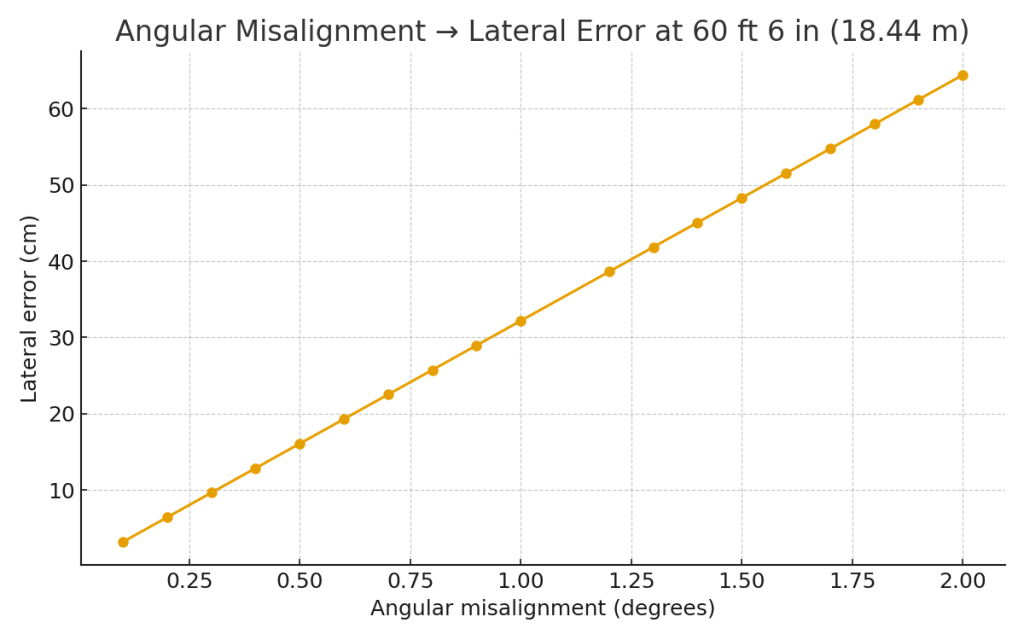
What’s interesting (I’m also not ruling out that this is entirely coincidental), is according to the former Director of Pitching for Driveline Chris Langin the average miss for intended throwing targets of MLB pitchers’ is 12.5-13 inches.
Trust me, I know this is hypothetical & circumstancial at best. But for the sake of my own curiosity & the dozen or so people who will read this blog post lets dig a little deeper.
In 1998 a study done by Laby et al., on “The Effect of Ocular Dominance on the Performance of Professional Baseball Players” 410 players throughout the Los Angeles Dodgers organization were assessed. Position players & pitchers were both used in the study. The conclusion was that ocular dominance had no significant affect on the players & showed no “statistical advantage”. The study only examined ERA & Batting Average. It excluded pitchers from batting average.
| Group | Same Dominance | Crossed Dominance |
|---|---|---|
| Major League Batting Avg | 0.271 | 0.251 |
| Minor League Batting Avg | 0.274 | 0.270 |
| Major League ERA | 3.34 | 3.56 |
| Minor League ERA | 4.00 | 4.20 |
Where the study has some holes is eye dominance was determined using a “modified Bryngelson technique”. Which was the equivalent of holding a paper towel tube up to a target w/ both eyes open & declaring which eye the tube is in front of. The hitters’ hand dominance was determined based off “the side of the plate they most often hit from”. It doesn’t mention taking into consideration switch hitters or the throwing arm of any position player. Pitchers’ dominant arm was based on their throwing arm. What is more concerning there is no mention of ocular dominance being contextually specific to the task. Nor, that ocular dominance can shift based on binocular rivalry or the posture of the athlete. Additionally, athletes who have central or mixed dominance were never mentioned. I think its worth buying or in some cases leasing a device that can have a more systematic approach to assessing ocular dominance. There are several options available. It is also worth noting that only ERA & batting averaged were examined. No other metric or statistic was even considered. So for me, this needs to be revisited & tested out in more rigourous methods.
Conclusion: Next Steps
I like thinking in systems, so my first thought would be what already exists in the world of shooting & what could we possibly test for and hypothesize? My first thought goes to using one of the better pieces of technology available to assess ocular dominance. Then look at current research on how ocular dominance can shape misses in shooting sports. Since I like summarizing information on charts, here’s another quick hitter.
| Dominance Pattern | Typical Error Direction (if uncorrected) | Empirical Evidence / Source |
|---|---|---|
| Cross-dominant (right-hand / left-eye or vice versa) | Misses toward the dominant-eye side (e.g., right-hand + left-eye → left of bullseye) | Murchison & Zaman 2009 (Ophthal Physiol Opt); Knapp et al. 2005 (Sports Eng.); Haake & Knapp 2006 (Sports Eng.) |
| Same-side (uncrossed) | Minimal lateral bias; generally most accurate when properly aligned | Konttinen et al. 1998 (Scand J Med Sci Sports) |
| Alternating / weak dominance | Variable left-right drift, inconsistent grouping | Chawla 2022 (Himalayan J Ophthalmol review); Mapp et al. 2003 (Behav Brain Sci) |
| Suppression / dominance conflict (fatigue, bright light) | Random lateral dispersion; larger group size | Porac & Coren 1976; Haake & Knapp 2006 |
So I would then base my hypothesis off of the research summarized above. Would pitchers’ misses be similar to the patterns above? I’d also be curious how much dominant eye alignment matter or if it does at all. There already exists systems to tag intended targets, so it would be easy to integrate that as well.
One interesting side quest I went on was gaze fixation & stabilization on the intended target. With the glove prep changing from when I pitched, there isn’t the inherit, “give ’em a target to throw at” notion anymore. Reading through all the shooting research & seeing how important it is to be able to fix, hold, & stabilize your gaze on the intended target I’d be curious to compare that to pitching. Should we be painting small targets on the catcher’s gear to help guide visual focus? Perhaps a post for another time, but I like the idea of gathering techniques for target accuracy from shooting sports. At least for now, until its proven a fruitless endeavor.
 Baseball Thought Experiments